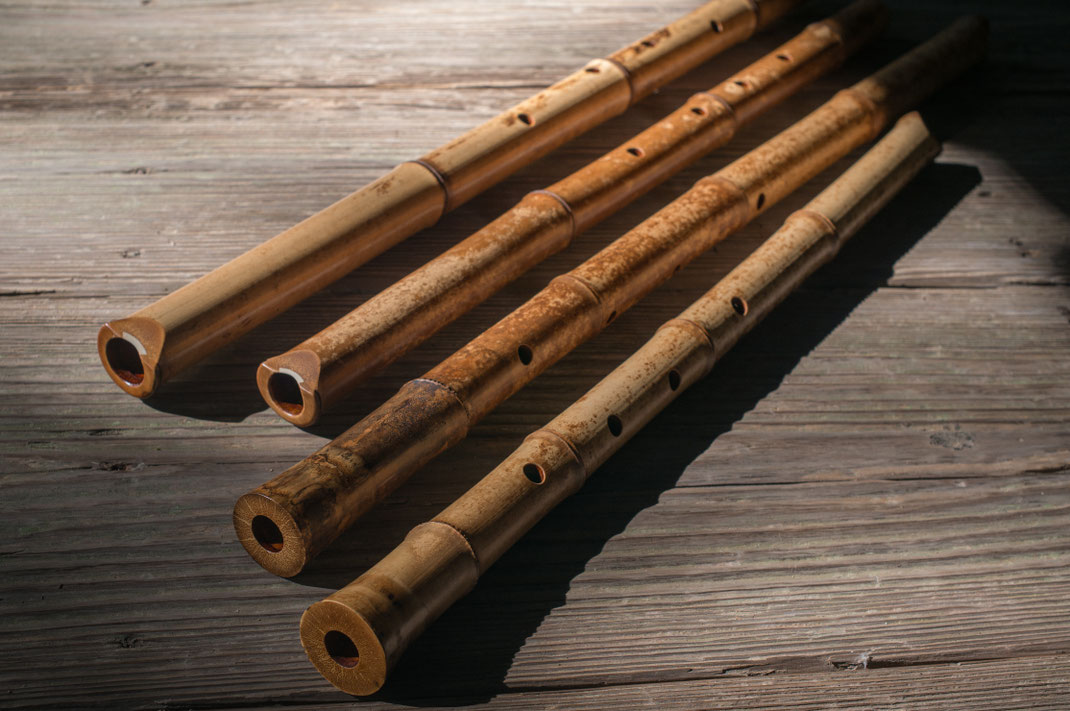
Ikegami Jinashi


媒体の響き


科学的には、エアリード楽器における材質の音への影響はぼぼ無いと結論付けられている研究データが存在します。しかし、私の耳にはこれらの結果は実感と大きく異なり、人間の感覚はこの研究で行われた周波数測定よりも遥かに感度が高いものだと確信してます。尺八の魅力とそれらの感覚は、密接な関係があり、池上銘の制作に於いても最重要視します。地無し尺八の「地」とは、石の粉を漆で固めた内部に盛るパテの事で、尺八を量産化する為に現在も使われています。「地」を使用することで、内径を自由に整形する事ができ、ある種の高性能化に成功しました。これを現在では「地付き尺八」と言われています。しかし、鐘の中に泥を盛った状態のように媒体の響きの豊かさは失われます。池上銘は一切のパテなどは使わず、高品質な自然素材のみで制作し、自然物の持つ美しい媒体の響きを兼ね備えた楽器を追求します。


真竹の発祥地とされる九州全域を巡り、理想的な条件を満たす竹を自ら採取しています。乾燥後も、一般的に行われる「溜め直し」(熱で竹をまっすぐに曲げ直す作業)は施しません。これは、竹の内径がわずかに歪むことで音に悪影響を及ぼす事を嫌う為です。また熱矯正された竹は、曲げられたストレスにより非常に割れやすい状態になります。池上銘の使用する竹の条件として、溜め直しの必要のない真っ直ぐさ、竹の年齢6.7年(竹林自体は推定百年以上)、適切な節の数、設定した理想値から±1ミリ以内の内径、音の明るさを左右する肉厚(誤差±1ミリ以内)。これらの条件を満たす竹は1万本に一本程であり、まさに自然の傑作と言える竹のみで制作します。※(池上銘は竹材の採取から仕込み、調律に至るまで、すべて自然の理に倣って全て手作業で行われます。そのため、年間にお届けできるのは15本に満たない数となります。)


ジョイント無し


一本の竹をそのまま使うことで楽器の一体感を重視。尺八のジョイントが作られた背景には、竹材の長さ調整の為や、同じ長さの尺八を量産する為の商売上の都合があります。それをきっかけに貴重だった尺八の量産化には成功しました。しかし、それと引き換えに一体感のある響きの気持ち良さは失われました。多くの楽器において共通しますが、繋ぎ目のないソリッドな構造である事が理想とされています。例えば、鐘を半分に切って貼り合わせた場合、音量やピッチ(性能)はそれほど変わりませんが、気持ち良さや響きのみに甚大な影響を及ぼします。これらの理由により、池上銘はジョイントのない尺八のみを制作します。


竹の音を抽出


竹の内径のディテールが生み出す複雑さ。これが竹を使用する理由であり、池上銘の音の源泉です。すなわち竹の内径は傷すら付けず、歌口・指穴・節などその他の要素と勘を最大限に駆使して調律します。この調律方法は一切の修正ができず一つの判断ミスで、奇跡的な条件を兼ね備えた竹材を廃棄する事になる為、竹に合わせて正確な判断を膨大な工程全てで行う必要があります。全てのプロセスは、竹のディテールを浮き彫りにし、音として味わう為に行われます。


国産極上漆


国産漆は、『血の一滴』と言われる程希少で、全体の流通量の僅か3%程しかありません。国産漆を採用する理由は『音』にあります。外国産漆に比べてゴム成分が少なく、竹のディテールを維持したまま、より薄く硬い塗膜を形成出来るからです。更に、耐水性、耐薬性、耐久性、防虫性を持ち合わせ、外国産漆に比べて、音の密度が大幅に向上し、非の打ちどころのない高性能を誇ります。


歌口


複雑な竹を存分にドライブ出来るパワーと弱音の美しさが際立つ滑らかさを備えます。歌口設計は理想の音を得るために研究を重ねた独自の形状を全製品に採用。池上銘は持ち替え時の違和感を限りなく排除します。歌口の素材によって、音の立ち上がりや響きは大きく変化します。あえてエッジを入れない地無し本来の仕様から、様々な材質での研究を重ねた末に、水牛の角や鹿の角などを採用してきました。それぞれの素材が持つ密度や弾力性といった音響特性を考慮し、一本一本の竹との相性を丁寧に見極めています。素材の個性を活かすことで、余分なノイズを抑え、滑らかで息通りの良い演奏性を実現しています。また、接着剤による音質へのわずかな影響も考慮し膠を使用。乾燥時に引きつけ合う性質により密着性が高く、音の伝達効率を向上させます。池上銘は構造的、素材的な音質の要素の組み合わせを駆使し歌口をデザインしました。


共鳴


かつて「十割法」と言われる指穴位置算出法が発明され、現在の尺八の設計のルーツとなっています。「十割法」は長さの個体差のある竹で作る条件下では中々優れた算出法であり、「十割法」の尺八によって古典と言われる曲たちは作られ、演奏されました。しかし、「十割法」には一種の音程のバグが含まれ、ツは低く、チは大幅に高く、裏穴も高い傾向あり、これからをコントロールしながら演奏する必要がありました。ピッチ(周波数)を合わせた時に起きる共鳴の心地良さや安心感は、人類の普遍的な感覚であり、尺八おいても同じ事が言えます。池上銘は筒音に対する相対ピッチを揃え、共鳴感を常に感じられるピッチ設計で、調律を施します。特にズレの大きかったチ(完全5度)は、音楽的、倍音構成上最も重要でり、これを筒音に含まれるチ(完全5度)に合わせる事の効果は絶大で、これまでの地無し尺八と比較して全域に渡って安心感のある共鳴感が得られます。単純にチューナーに頼って音の高さを合わせるだけではなく、その竹が持つ音色を含めたピッチ感も考慮することで軽い力で反応し、その有機的な倍音が、また減衰する音の美しさが際立ちます。


仕様


根あり  重厚感と深遠な余韻


原始的な尺八の本質を極限まで凝縮した、虚無僧スタイルへのオマージュ。

重厚な音色を得るために、根の部分を使用。表情豊かで粘り強い演奏を可能にし、余韻の深さが際立ちます。


根なし  躍動する生命力と純粋な響き


圧倒的な扱いやすさと、より生命力のある神秘的な音を奏でます。

根の少し上を使用することで魅力的なテーパー構造を持ち、楽器全体の音質が明るめになります。

根を削る工程を介さないため、竹本来の「100%純粋な内径」をそのまま楽器へと昇華させています。


江戸  160年の時が醸す、奇跡の倍音


江戸時代の竹材に現代の感性を宿した、夢の尺八。

160年以上民家の天井材として燻されることで化学変化を遂げたこの竹材は、奇跡的な特性を持つ極めて稀少な素材です。もはや新たに採取することが不可能で、将来的に枯渇が避けられないため、まさに唯一無二の存在と言えます。

音の密度は非常に高く、遠達性に優れた輝かしい倍音を誇ります。『根なし』のプレミアム版として、歴史と現代が交差する究極の一本です。


竹花入 一輪の野花に、悠久の景色を映す


尺八制作と同じ素材理解と構造思想から生まれました。

日本文化の長い年月を経て育まれた貴重な煤竹の中から、純度の高いひと節を選び抜き、竹と対話しながら仕上げています。生漆を薄く塗ることでカビや割れを防ぎ、日常使いが可能です。

煤竹ならではの深い色合いは、使い続けることでさらに艶を増し、静かに完成へと近づいていきます。


竹花入取り扱い方法 

・基本的に水は1~3日で捨て、内部をよく乾かしてください。 

・直射日光や強風を避け、風通しのよい日陰で自然乾燥させてください。(急激な乾燥は割れの原因になります。) 

・曲がりや水跡、色の変化は劣化ではなく、時間が刻む景色です。

Resonance of the Material


Scientifically, research data suggests that the material of air-reed instruments has almost no effect on sound. However, my ears perceive something quite different, and I am convinced that human sensitivity far surpasses the frequency measurements conducted in these studies.The charm of the shakuhachi is deeply intertwined with these sensations, and I prioritize them above all else in the creation of Ikegami instruments.In ji-nashi shakuhachi, the term "ji" refers to a paste made of stone powder and lacquer, applied inside the instrument. This paste is still widely used today to facilitate mass production. By using ji, the inner bore can be freely shaped, achieving a certain level of high performance. This type of instrument is now referred to as "ji-ari shakuhachi." However, just as filling a bell with mud diminishes its resonance, the rich natural vibration of the material is lost.Ikegami shakuhachi are crafted entirely without the use of any paste, relying only on high-quality natural materials to pursue an instrument that embodies the pure resonance of nature.


Bamboo


I personally travel across Kyushu, the birthplace of madake bamboo, to hand-select bamboo that meets the ideal conditions. Even after drying, I do not perform the commonly used process of "tame-naoshi" (heat correction to straighten the bamboo). This is because even slight distortions in the inner bore can negatively affect the sound. Moreover, heat-corrected bamboo is highly prone to cracking due to the stress of being bent.The bamboo used for Ikegami shakuhachi must meet stringent conditions: it must be naturally straight without the need for tame-naoshi, be 6–7 years old (The bamboo grove itself is estimated to be over 100 years old.), have an appropriate number of nodes, an inner diameter within ±1mm of the ideal measurement, and a wall thickness (which influences brightness of tone) with a tolerance of ±1mm. Such bamboo is found in only one out of ten thousand stalks. I craft my instruments exclusively from these true masterpieces of nature.   ※(Ikegami flutes are crafted entirely by hand, guided by the laws of nature—from the initial harvesting of the bamboo to the seasoning process and final tuning. For this reason, fewer than fifteen of these instruments are brought into the world each year.)


No Joints


By using a single piece of bamboo, the integrity and unity of the instrument are prioritized. The introduction of joints in shakuhachi originally served commercial purposes—allowing for length adjustments and facilitating mass production. While this helped make shakuhachi more widely available, it came at the cost of losing the cohesive resonance that makes playing so enjoyable.As with many other instruments, a solid, seamless construction is considered ideal. For example, if a bell were cut in half and reassembled, its volume and pitch (performance) might remain unchanged, but its resonance and tonal richness would be significantly diminished.For this reason, Ikegami shakuhachi are made exclusively without joints.


Extracting the Sound of Bamboo


The complexity of the bamboo's inner bore details is what makes bamboo the chosen material, and it is the very essence of the Ikegami sound.Thus, I leave the bore untouched, tuning the instrument through precise adjustments to the utaguchi (blowing edge), finger holes, and nodes while relying on intuition and craftsmanship.This tuning process allows no room for error—one mistake could render a rare and perfect piece of bamboo unusable. Every step of the process requires precise judgment to bring out the true character of the bamboo.All processes serve the purpose of making the detailed nuances of the bamboo audible and appreciable in sound.


Finest Domestic Urushi Lacquer


Domestic urushi lacquer is so rare that it is often called the "blood of a single drop," comprising only about 3% of the total market supply.The reason I use domestic urushi is because of its effect on sound. Compared to foreign urushi, it contains less rubber content, allowing for the formation of a thinner yet harder coating while preserving the bamboo’s details.Additionally, it boasts superior water resistance, chemical resistance, durability, and insect resistance. Compared to foreign urushi, it significantly enhances the density of sound, offering unparalleled performance.


Utaguchi (Blowing Edge)


This instrument possesses the power to fully drive complex bamboo, combined with a smoothness that highlights the beauty of quiet tones. For the utaguchi (blowing edge) design, a unique shape developed through extensive research to obtain the ideal sound is adopted across all products. The Ikegami brand eliminates any sense of discomfort when switching instruments to the absolute limit.The attack and resonance of the sound change greatly depending on the material of the utaguchi. Moving on from the original jinashi specification that intentionally does not include an inlaid edge, through repeated research on various materials, we have adopted materials such as water buffalo horn and deer horn. Considering the acoustic characteristics of each material, such as density and elasticity, we carefully judge the compatibility with each individual piece of bamboo. By utilizing the individuality of the materials, we suppress excess noise and achieve smooth playability with excellent breath flow.In addition, considering even the slightest influence of adhesives on sound quality, nikawa (animal glue) is used. Due to its property of drawing together during drying, the adhesion is high, improving the efficiency of sound transmission. The Ikegami brand designed the utaguchi by making full use of the combination of structural and material elements of sound quality.


Resonance


The "Towari Method," a technique for calculating finger hole positions, was invented in the past and became the foundation of modern shakuhachi design. This method was quite effective for crafting shakuhachi from bamboo, which naturally varies in length. Many classical pieces were composed and performed using shakuhachi made with this method.However, the Towari Method contained certain pitch inconsistencies: the "Tsu" note tended to be lower, the "Chi" note significantly higher, and the back hole also had a tendency to be sharp. As a result, players had to actively control these pitch discrepancies while playing.The sense of comfort and security that comes from harmonic resonance when pitches are aligned is a universal human experience, and the same applies to shakuhachi. Ikegami instruments are tuned to ensure a consistent relative pitch relationship with the fundamental note, allowing for a rich and continuous resonance.The "Chi" note (perfect fifth), which had been particularly misaligned, is one of the most crucial tones both musically and in terms of harmonic overtones. By adjusting it to match the perfect fifth naturally present in the fundamental tone, the effect is profound—compared to conventional jinashi shakuhachi, Ikegami instruments offer a sense of harmonic stability across the entire range.Rather than merely relying on a tuner to match standard pitch, Ikegami shakuhachi take into account the natural tonal qualities of the bamboo itself. This results in a highly responsive instrument that produces organic overtones and highlights the beauty of decaying notes.


Specifications


Neari    Profound Gravity and Deep Resonance


An homage to the Komuso style, distilling the primitive essence of the shakuhachi to its absolute limit.

To achieve a heavy tone, the root portion is used. This enables expressive and tenacious performances, and the depth of the resonance stands out.


Nanashi    Vibrant Vitality and Pure Resonance


It offers overwhelming ease of use and produces a more vital, mystical sound. By using the section slightly above the root, it possesses a captivating tapered structure, and the overall tonal quality of the instrument becomes brighter. As it does not undergo the process of carving the root, the bamboo's original "100% pure inner diameter" is sublimated directly into the instrument.


Edo    Miraculous Overtones Brewed by 160 Years of Time


A dream shakuhachi that instills modern sensibility into bamboo from the Edo period. Having undergone a chemical transformation by being smoked as ceiling material in private houses for over 160 years, this bamboo is an extremely rare material with miraculous properties. It is truly a one-of-a-kind existence, as it is no longer possible to harvest newly, and its future depletion is inevitable. The sound density is remarkably high, boasting brilliant overtones with excellent projection. As a premium version of "Nanashi," it is the ultimate instrument where history and the modern era intersect.


Bamboo Flower Vase    Reflecting Eternal Landscapes in a Single Wildflower


Born from the same material understanding and structural philosophy as shakuhachi craftsmanship. From among the precious smoked bamboo nurtured over long years of Japanese culture, a single node of high purity is selected and finished through a dialogue with the bamboo. A thin layer of raw lacquer is applied to prevent mold and cracking, making it suitable for daily use. The deep coloring unique to smoked bamboo will gain further luster with continued use, quietly approaching a state of perfection.


Handling Instructions

・In principle, discard the water after 1 to 3 days and allow the interior to dry thoroughly.

・Avoid direct sunlight and strong winds; allow it to dry naturally in a well-ventilated, shaded area. (Rapid drying may cause cracking.)

・Warps, water marks, and color changes are not deterioration, but rather a landscape carved by time.